If You Are Found Innocent Can You Be Tried Again
The answer to this question involves one person: the local commune chaser. He or she has broad discretion over whether to take a instance to trial, or, in the Curtis Flowers case, to repeated retrials.
If a prosecutor takes a criminal case to trial and the defendant is found not guilty, then it's over. The 5th Subpoena to the U.S. Constitution forbids the government from re-prosecuting someone for a crime once they've been acquitted — this is commonly known as double jeopardy.
Only what'south happened in the Flowers case is different. Flowers has never been acquitted. In his commencement iii trials, he was convicted. Those convictions were later on thrown out past an appeals court, which ruled that the prosecution made critical mistakes. Each fourth dimension, the guilty verdict was essentially erased from the books, and the case went back to the beginning. The next two juries — in trials 4 and five — never reached a verdict. They just deadlocked and the proceeding ended in a mistrial.
After each ane of these first five trials, the prosecutor in the instance, Doug Evans, had a choice to make. Would he drop the murder charges against Flowers and release him or try again to convict him? And each time, Evans, who's been in office for more than two decades, chose to try Flowers again. The sixth trial'southward guilty verdict has so far held upwardly.
Double jeopardy doesn't apply because, in consequence, Flowers hasn't endured half dozen trials for the same criminal offence. He'due south but had a kickoff trial — six times.
In that location'due south nothing in the police force that confined a prosecutor from doing this — from retrying a case when the jury hasn't reached a unanimous verdict or a conviction hasn't stuck. That said, there'due south null that requires a prosecutor to effort a case over and over again, either — and well-nigh don't.

How often does this happen?
No one tracks instances of repeated prosecutions at a national level. Even at a local level, these cases live on by and large in the memories of the attorneys and clerks that handled them. We conducted an informal poll of state prosecutors, defense attorneys, legal scholars, lawyers' associations, and civil rights organizations. Had any of them heard of someone, other than Curtis Flowers, being tried 6 times for the same crime? The respond was unanimous: Nope.
At that place are some examples if you dig. Between 2000 and 2005, a Mississippi man named Marcus Roberson was brought to trial 8 times on murder charges. Just v of those trials really reached the jury deliberation phase. The other 3 were declared mistrials at the kickoff. After the concluding mistrial, Roberson pled guilty to manslaughter. Multiple prosecutions exercise happen, but they are rare.
"There's an unspoken rule that 3 times is sort of the max," said Hermann Walz, a former assistant commune attorney in New York City and professor at John Jay College of Criminal Justice. "After three, near prosecutors decide that the evidence simply isn't in that location."
Walz said that certain factors can encourage a prosecutor to try a case a second or third time. If only one or ii holdouts prevented the jury from reaching a guilty verdict, the case may yet seem solid. If the jury convicted the defendant but that conviction was overturned on procedural grounds, a prosecutor might feel that correcting those errors and trying again is function of his duty to protect the public from a potentially dangerous criminal.
There tin be upsides to a do-over. "Usually the 2d time around information technology gets better for the prosecution," said Melba Pearson, deputy manager of the Florida ACLU and a long-time prosecutor in Miami-Dade Canton. "You're presenting the aforementioned evidence, you kind of know what worked and what didn't."
But multiple trials tin also rack up costs in taxpayer dollars, jurors' time, and stress on victims and their families. And the instance itself starts to fall apart. "Past the tertiary time trying the case, you lot're losing witnesses," Pearson said. "People retire, people pass away, people move, people say, 'Yous know what, I'yard fed upwardly, I don't want to be a part of this anymore, don't call me.'"
And so why keep pushing?
"The stated reason to re-prosecute a instance is almost always a continued belief that the individual is actually guilty of the crimes charged," said John Hollway, executive director of the Quattrone Center for the Fair Administration of Justice at the University of Pennsylvania Police force Schoolhouse. "What'south more difficult to parse is any potential unstated rationale."
Political pressure to prosecute can be immense. In about every jurisdiction in the Us, district attorneys are elected officials. Failure to secure convictions tin sink an upcoming campaign. This is especially true in loftier-profile cases, where the victims are prominent citizens or outspoken advocates or the crime is especially heinous.
"When confirmation bias toward the state'southward theory of the crime combines with the psychological fear of embarrassment or error ... it is easy to see how fifty-fifty a well-intentioned prosecutor might cling desperately to bodily guilt as a rationale for standing to prosecute the case," Hollway said.
And when a prosecutor does cling to a example, there are only a few ways to put an end to it — all of them difficult to come past.
The first is a judicial finding, oft by an appeals courtroom, of bodily innocence — when in that location's new evidence or a Deoxyribonucleic acid exoneration, for example. The second is an amortization in a retrial. The third is a successful motility past the defense to go the prosecutor disqualified from pursuing the case any further.
"The argument would be, 'Hey, if this had been a fair trial, this guy would be acquitted and double jeopardy would apply," Hollway said. "The defense attorney is basically saying, 'Come up on. You don't get to misbehave so retry the guy.'"
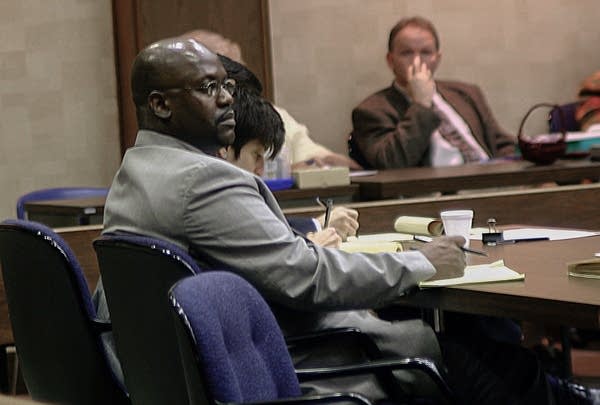
Before Curtis Flowers' 3rd trial, his defense squad attempted something forth these lines. Attorney John Gilmore wrote a movement that was the first procedural stride toward having Evans removed from the case. Gilmore cited legal precedent for disqualifying a prosecuting attorney in a case where he's shown bias or has engaged in serious misconduct.
The approximate, Clarence Morgan, didn't take much time to consider Gilmore'due south argument. He issued his ruling the very same day that the motion was filed — in a fast-moving hearing that was essentially a lightning round of pretrial motions. Rolling out of one motion and into the adjacent, Judge Morgan put the question of Doug Evans' disqualification to Doug Evans himself.
"Mr. Evans," the judge said, "do yous know of any reason yous ought to be butterfingers now?"
"Not that I'g aware of, Your Accolade," Evans replied.
"Based on that argument," Judge Morgan said, "the motion is overruled."
Doug Evans would stay on the case. And not long afterwards that, Curtis Flowers went on trial again.
The 2nd season of the In the Night podcast is about the instance of Curtis Flowers, who was tried six times for the aforementioned crime. Learn more than.

Source: https://www.apmreports.org/story/2018/05/01/how-can-someone-be-tried-six-times-for-the-same-crime
0 Response to "If You Are Found Innocent Can You Be Tried Again"
Post a Comment